5 Good Reasons to Wrap Your Vehicles
Switch Old Yellow Page Advertising Dollars to Investments in Eye-Catching, Moving Billboards
Here are 5 Good Reasons to Wrap Your Vehicles at your business in Waynesboro, Staunton, and Augusta County, Virginia. Companies are replacing investments in Yellow Page ads with electronic digital signs and vehicle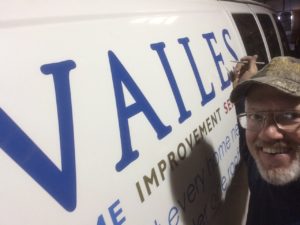 wraps, the two best advertising bangs for their bucks these days.
Back in late November, I closed a deal to letter 2 vans and a box truck for Vailes Heating and Air of Fishersville, Virginia. In early December, my mother got sick and I had to put the project on hold. My mom passed away in January, and I did not start on the vehicle re-branding project until late January, early February. After I did the first van, the customer decided to re-brand seven vans instead of two, and I completed them all this week.
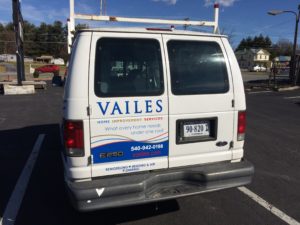 The customer chose what I term “partial vehicle wraps” where in this case the bottoms of the vehicles boast bold, blue wavy stripes that cover the entire lower portion of the vehicles, while the tops sport traditional cut vinyl graphics. The renovated fleet of vehicles is eye-catching. Every day I see one of the new vehicles on the road and they now keep up with competing companies’ vehicle advertising out there on the streets of Augusta County!
Re-Brand Your Vehicles for Brand Continuity
Vailes Heating and Air offers several services and they used different vans to promote them: Home 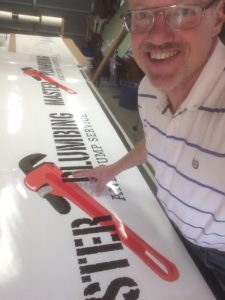 Renovations, Heating and Air, Plumbing, Pools and Spas. Their old vans suffered what we termed “brand crisis” and it was hard for customers to figure out what Vailes was all about as their vehicles sped down the road or pulled up in their drive.
After meeting with the C-Level people in charge of business strategics, we decided to highlight the Vailes name and sub-highlight the various services. They developed a main brand and three sub-brands with the help of a local graphic designer, and the new vehicle graphics weave the various identities together so the branding makes sense and is consistent across all the vehicles and brands.
Make a Worn-Out Fleet Look Like New For Less
Over time a corporate fleet can get ragged.
The Vailes fleet consisted of standard Chevy and Ford vans. They were the typical, basic-white work vans and were fairly the same size and design so that the graphic design stayed consistent across all the vehicles. The only slight variation was that the Ford body lines accommodated a shorter bottom stripe than the Chevy’s.
The old vehicle graphics were not only inconsistent, but were also faded and deteriorated. The old graphics were removed with chemicals and heat, and the vehicles were buffed before the new vinyl graphics were applied. One of the administrators at Vailes said the vehicles looked like new after they were re-lettered, and commented on the cost difference to renovate the vans with graphics versus buying a whole new fleet of vehicles. That was great information to consider as companies make these types of decisions.
Create 24-Hour Visibility of Your Brand
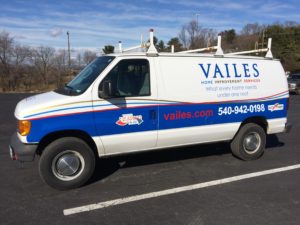 Every day I go to Lowes or Wal-Mart or any place that has a big parking lot in town, I notice the many brands of area businesses on parked vehicles. It’s hard to miss them unless you’re blind. They are everywhere and are becoming the new way to spend advertising dollars. When you letter your car, truck or van you create a moving billboard that is out there working every day!
The neat thing about vehicle lettering as an advertising tool is that you can choose how much you want to spend. It’s like taking an ad out in the paper or Yellow Pages. You can have a one-line or one-column black and white ad or a full-page, full-color charmer. That’s completely up to you. For Augusta Sign Company, I personally choose to use a set of magnets with my brand for my front doors and a decal on my spare tire cover in the back, but some people want full vehicle wraps.
Full wraps take lots of talent and experience and I just don’t have the patience to tackle them on a regular basis, but I’d recommend using some new guys in the field for that: Walter and Geiger Hansen at Viking Forge Design in Waynesboro. I’ve been in their shop a few times and the last time I was there they had wrapped an entire car and it looked like it was painted. God bless them for having the skill patience to be able to do this!
Keep Up With The Jones’s
Many of your competitors have already produced flashy vehicle advertising that is getting lots of chatter out in the 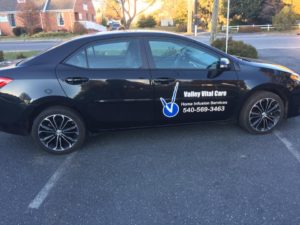 community. It’s your choice to keep up or not. I personally don’t want to be swamped with business that I would not be able to keep up with being a small sign shop. But if you want more work, then professional vehicle wraps are a great way to go!
Consider partial wraps to save money. The construction services company that hired me to letter their fleet had gotten pricing on full wraps that were more than double the cost of my partial wrap solutions. It never hurts to shop around.
I guess that about wraps it up!
Mark Hackley is owner of Augusta Sign Company in Waynesboro, VA 22980 540-943-9818
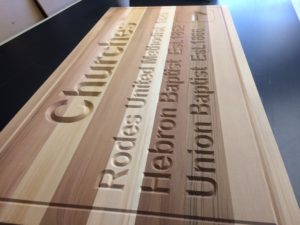 most sign buyers!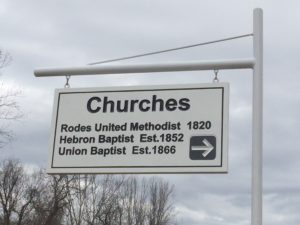
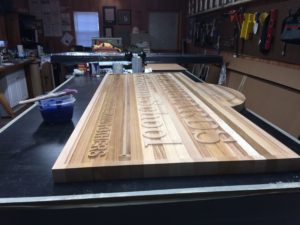 RECIPE FOR A WOOD SIGN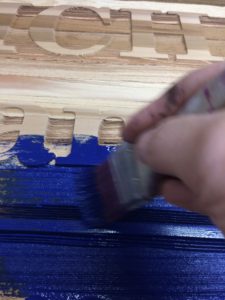
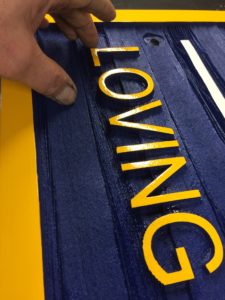 background, then you peel the stencil and the sign is done. However, that isn’t always the case, and more than half the time you have lots of touch ups or worst case is you end up having to re-sand, prime, and paint because the stencil pulls the finish.
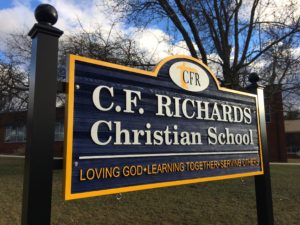 the cost per month (CPM) of the advertising. If the sign lasts 50 years with 3 maintenance periods and the monthly cost ends up being eleven dollars a month for very high-impact branding. Unfortunately, the C.F. Richards Christian School is not on a main thoroughfare, so the traffic count is mostly made up of parents, staff and neighbors and their friends living on the residential street where it’s located. Otherwise, if on a highly traveled street with high traffic count, the cost per impression would be extremely low at $11.00 a month. Compare that with TV, radio, magazine or newspaper advertising, and you’ll see that signage is one of the few marketing options that has great value. Kind of up there with blogging on the internet!!